
SIGNIFICANT TRANSFORMATION OF LEADERSHIP
at the speed of today's world

We agreed:

The efficiency of 1:1 mentoring (with humans and AI),

Continuous support for the implementation of learning, with periodic evaluations (self-evaluation, evaluation of the direct leader and the team),

Measuring individual and group progress.
trainings
traditional
are not enough to prepare the leadership
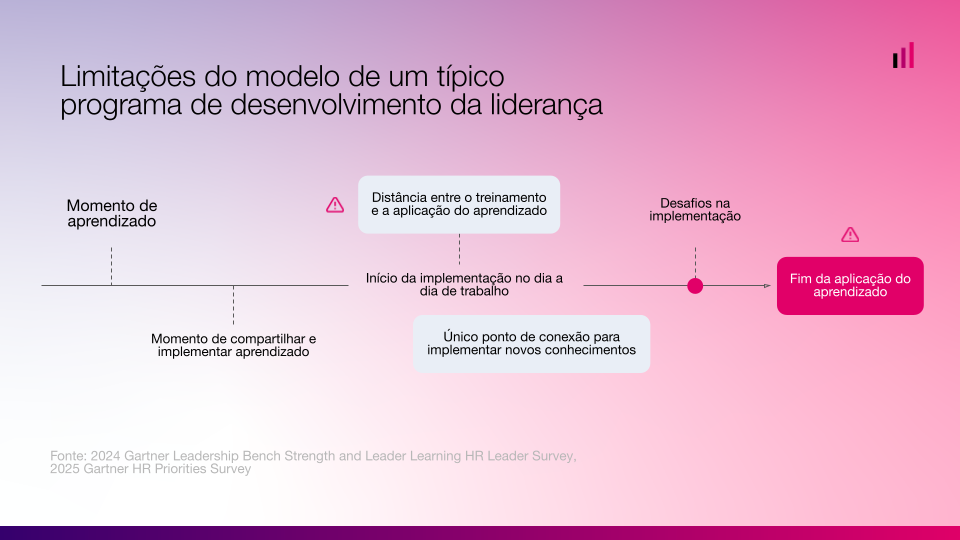
The traditional models leadership development programmes usually have 1 learning moment and, as they have no personalisation or follow-up to apply what the leader has learnt, the knowledge is wasted, and so is investment.
The first time a leader encounters a challenge in implementing the knowledge acquired in a course, immersion or workshop, they have no one to turn to in order to learn how to overcome the challenge, and they give up. This is shown in the diagram below, from a Gartner study.

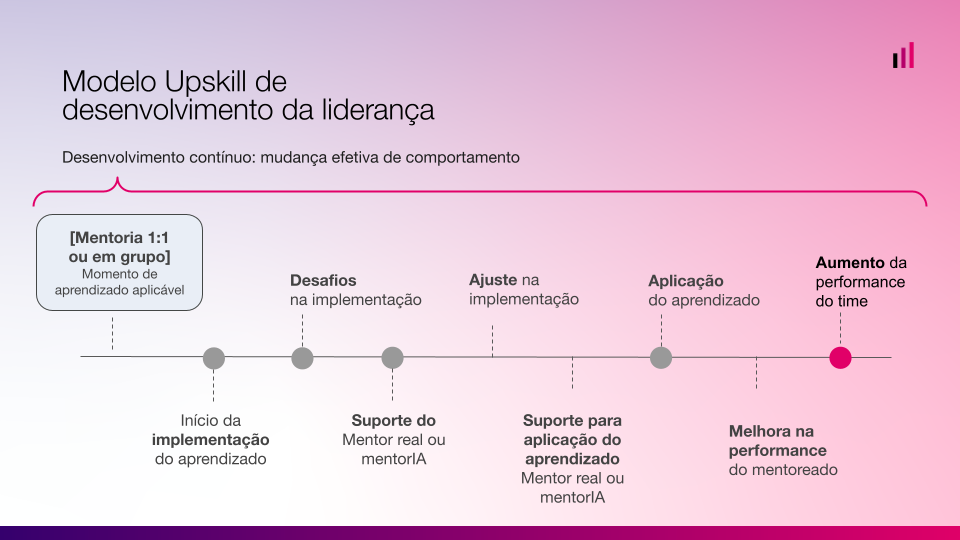
The Upskill development model
In the Upskill model, the 1:1 or group mentoring brings content and reflections about the leaders' day-to-day experiences. From the mentoring session, the leader leaves with a mission or a tool to implement in the work routine and train your skills or solve a challenge.
When he comes across doubts or difficultiesyou can consult the human mentor or AI to clarify details of the implementing learning. With this support, day by day, week by week, there is a reinforcement of learning and honing of skillsuntil it is consolidated, generating more performance for him and the team.
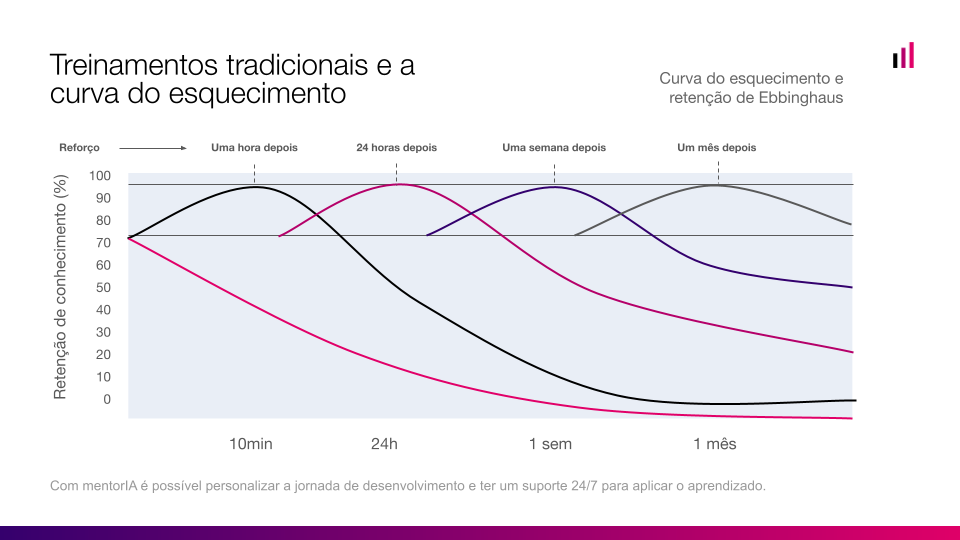
Forgetting and knowledge retention curve
Personalisation and monitoring the implementation of learning help each leader to really transform their behaviour, and much more quickly than in the traditional model shown above.
You can see in the graph that when there are reinforcement points for learning - whether it's revising the content learnt or making an effort to implement the knowledge acquired - forgetting decreases, and may not even happen.
The 5 pillars that underpin our development methodology

Practical approach
The tools applied in our sessions go beyond theory and promote active learning, bringing insights for immediate application

Dialogue and reflections on behaviour
We provoke deep reflection on habits, attitudes and behaviours that interfere with performance and well-being.
Expertise with leaders
We encourage the exchange of visions, experiences and know-how, generating behavioural transformations that have an impact on results.

Skill-building day
We map the gaps in competences and skills needed to thrive in today's complex and fast-paced world

Power skill missions
At each meeting there will be a mission with the aim of applying the concepts in everyday life, solidifying the competence in development
Are your leaders facing different challenges and do they need to develop specific competences to overcome them?
Discover how the Upskill Development Model can accelerate and scale your leadership development.

Methodology accredited by Ryerson University
Our work has the backing of a study by Ryerson University in Toronto, Canada.
The study was based on the content collected through the application of an open questionnaire and scientifically validated questionnaires: Mindful Attention Awareness Scale (MAAS) - ®, Dispositional Resiliency Scale (DRS) -® and Self-Reflection and Insight Scale (SRIS), by PhDs Annabel Sibalis and Karen Milligan. See the main conclusions in the table below.

The methodology used by Upskill promotes:
- Increased self-perception
- Increased resilience and emotional stability
- Increased ability to focus
- Improved self-control
- Improved productivity
- Positive impact on career
- Improved physical and mental well-being
- Increased self-confidence.
The main factors that influence the behavioural change of mentees are:
- clarity of individual objectives and the feasibility of achieving them
- a positive connection with the mentor
- the mentee's confidence in the results (shown on the dashboard) that the programme can provide
- recognition that the programme's development purpose is genuine
- practical learning, as well as the mentee's ability to understand and apply what they have learnt.
- practical learning, as well as the mentee's ability to understand and apply what they have learnt.
The key mechanisms for change identified in the study are:
- creating a learning mindset
- know that the company is investing in your personal and professional growth
- insights and tools to improve focus, productivity, stress tolerance, emotional intelligence, creativity, collaboration and sense of purpose
- techniques for managing emotions and increasing focus.
 Português do Brasil
 Português
 English (UK)
 Español